





The penalty shootout is football’s most dramatic tiebreaker — a sudden-death format that reduces weeks of competition to a sequence of individual duels between a kicker and a goalkeeper twelve yards apart. Few sporting moments generate comparable tension, and few outcomes feel simultaneously so random and so decided by mental preparation. For those tracking knockout tournament results in real time, platforms like dafabet login provide access to live coverage and match data across all major competitions where penalties determine progression.
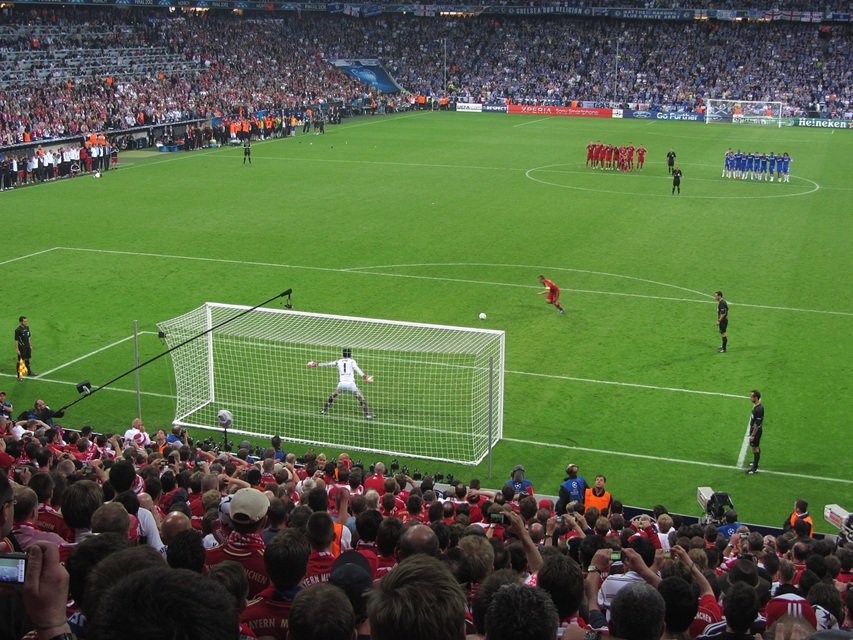
A penalty shootout game comes into play when a knockout fixture remains level after 90 minutes of regular time and, where applicable, 30 minutes of extra time. Each team nominates five kickers who take turns attempting penalties against the opposing goalkeeper. If the score remains tied after five rounds, the shootout continues on a sudden-death basis until one team scores and the other misses in the same round. The format appears deceptively simple — but the variables governing its outcome span biomechanics, psychology, statistics, and preparation strategy.
The Structure of a Penalty Shootout
A standard shootout follows a defined sequence with specific rules governing its conduct.
Coin toss determines which team kicks first. Winning the toss and choosing to kick first carries a measurable statistical advantage — research across thousands of shootout observations consistently shows that the team kicking first wins more often than the team kicking second, with estimates ranging from 54% to 60% depending on the dataset and competition level.
Alternating kicks proceed in rounds, with each team completing one attempt per round before the order repeats. Referees and assistant referees monitor the sequence, confirm goalkeeper positioning, and signal when each attempt can be taken.
Goalkeeper positioning rules require the goalkeeper to remain on the goal line, with at least one foot touching or in line with the goal line, until the ball is struck. Movement off the line before contact results in a retake if the penalty is missed; an encroaching goalkeeper whose early movement coincides with a saved penalty grants the kicker a retake.
All outfield players and the goalkeeper are eligible to take penalties, including substitutes who entered the field before the end of extra time. Teams must select five kickers in advance and cannot change the order once submitted, though additional kickers in sudden death can be nominated in any order.
Sudden death begins after the initial five rounds if scores remain level. In sudden death, any missed penalty by one team combined with a converted penalty by the other ends the shootout immediately.
Historical Development of the Format
Penalty shootouts were not always football’s standard tiebreaker. The format replaced the coin toss — and in some competitions, the replay match — as the definitive method for resolving knockout ties, but its adoption was gradual and contested.
The FIFA World Cup introduced the penalty shootout at the 1978 tournament for third-place play-off purposes, with the main knockout rounds adopting the format in 1982. Before that, drawn World Cup knockout matches were decided by replays, coin tosses, or drawing of lots — methods perceived as arbitrary even by the standards of the time.
European club competitions adopted penalties at various points through the 1970s, with the UEFA Champions Cup standardising the format during the same era. The ABBA format — where the team kicking second kicks first in the following round — was trialled in several youth competitions and friendly tournaments as a method of reducing the first-kick advantage, but has not been adopted at senior professional level.
Penalty Shootout Statistics: What the Numbers Show
| Metric | Value |
| Average conversion rate (professional level) | 72–76% |
| Goalkeeper save rate | 18–22% |
| Miss rate (off target or post/bar) | 6–10% |
| Win rate for team kicking first | 54–60% |
| Conversion rate under sudden death pressure | 65–70% |
| Conversion rate in rounds 1–3 vs rounds 4–5 | Round 1–3: ~78% / Round 4–5: ~68% |
The conversion rate drops noticeably in later rounds, reflecting accumulated psychological pressure rather than any change in technical conditions. Round five and sudden-death attempts carry the highest elimination stakes, and the measurable decline in conversion rates at these stages confirms the role of pressure in altering execution.
Goalkeepers save a smaller proportion of penalties than the raw miss rate might suggest — the majority of non-scored penalties result from kicker error rather than goalkeeper intervention. Diving to the correct side accounts for roughly 70–75% of all goalkeeper attempts; of those, only a fraction result in actual saves, as accurate placement in the corner of the net remains beyond most goalkeepers’ reach regardless of dive direction.
The Psychology Behind Penalty Kicks
The penalty shootout game is as much a psychological contest as a technical one, and the mental architecture surrounding each attempt shapes outcomes as decisively as technique.
Decision-making under pressure is the central challenge. Kickers must commit to a direction and technique before approaching the ball — last-moment changes in intent are strongly correlated with missed attempts, as the motor programme executing the kick conflicts with the revised instruction. Research in sports psychology identifies pre-kick decision commitment as one of the strongest predictors of successful penalty conversion.
Goalkeeper mind games represent a legitimate tactical element. Goalkeepers who delay slightly — within the rules — force kickers to hold their decision longer, increasing the window for doubt and indecision. Verbal communication, unconventional positioning on the goal line, and deliberate movement can all introduce uncertainty into the kicker’s approach.
Order effects within a team’s nominated sequence influence outcomes. Coaches face a recurring strategic question: place the most reliable penalty takers in rounds one and two to establish early momentum, or hold elite kickers back for decisive rounds four and five? Evidence from professional tournaments suggests front-loading reliable kickers produces better aggregate outcomes, as early misses disproportionately affect team confidence and subsequent conversion rates.
Preparation and research have become increasingly professionalised. Goalkeepers and coaching staff study archived footage of opposing kickers to identify directional preferences, run-up patterns, and tendencies under pressure. Kickers, conversely, vary their approaches across competitive appearances to reduce predictability in the dataset.
Technique: What Separates Converted Penalties from Misses
Penalty technique involves a defined set of biomechanical decisions, each with measurable implications for outcome.
Placement versus power represents the fundamental kicker trade-off. Placing a penalty into the bottom corner with moderate pace is statistically more successful than striking the same zone at maximum velocity — accuracy decreases as power increases, raising the risk of missing the target entirely. However, a placed penalty into a zone the goalkeeper correctly anticipates will be saved at higher rates than a powerful strike to the same location.
Height is an underused variable. Penalties aimed at the upper half of the goal — particularly the upper corners — are converted at significantly higher rates than low penalties, as goalkeepers diving to ground level rarely recover to reach above waist height. The technical challenge of consistently striking high penalties without ballooning over the bar limits the frequency of this approach.
Run-up length and angle both signal intent to attentive goalkeepers. Short, direct run-ups are associated with early commitment and side-foot placement. Longer, curved run-ups are more commonly associated with driven, instep strikes. Goalkeepers tracking these cues adjust their pre-dive reads accordingly.
Penalty Shootout Formats Across Competitions
| Competition | Format Used | Extra Time Before Shootout | Sudden Death Rule |
| FIFA World Cup (knockout) | Standard 5-kick alternating | 30 minutes | Yes, from round 6 |
| UEFA Champions League | Standard 5-kick alternating | 30 minutes | Yes, from round 6 |
| UEFA European Championship | Standard 5-kick alternating | 30 minutes | Yes, from round 6 |
| Copa América | Standard 5-kick alternating | 30 minutes | Yes, from round 6 |
| FA Cup (from QF onwards) | Standard 5-kick alternating | 30 minutes | Yes, from round 6 |
| League Cup (EFL Cup) | Penalty shootout without extra time | None in some rounds | Yes, from round 6 |
| Friendly / pre-season | Variable — some use ABBA format | Variable | Variable |
The elimination of extra time before penalties in certain domestic cup competitions — particularly early rounds of the EFL Cup — reflects a broader administrative preference for scheduling efficiency. The absence of 30 minutes of additional play changes the physical and psychological context: players enter the shootout without the fatigue accumulation of extra time, altering the physiological conditions under which penalties are taken.
Notable Tactical Adaptations
Penalty shootout preparation has evolved from informal intuition to systematic analysis over the past two decades. Several tactical adaptations have become standard practice at elite level.
Specialist penalty coaches work exclusively on shootout preparation at some clubs, developing individualised technique and mental routines for each potential kicker. This represents a significant shift from the era when penalty preparation was a marginal element of pre-match training.
Psychological profiling identifies which players perform best under elimination pressure versus those whose conversion rates drop significantly relative to their training performance. Coaches factor this data into the selection and ordering of nominated kickers.
Goalkeeper data packages — compiled by analysts and delivered before and during the shootout — give goalkeepers structured information on the directional tendencies of each opposing kicker. The practical value of this information depends on its recency and the sample size of archived attempts.
Kicker rotation across competitions ensures that nominated penalty takers do not develop a recognisable and searchable pattern across multiple seasons, reducing the predictive value of historical footage for opposing analysts.
The penalty shootout remains an imperfect but irreplaceable format — a mechanism that resolves genuine competitive deadlock within a single match while generating moments of individual pressure and collective drama that no other tiebreaker in team sport replicates with the same intensity.